How Much Does A Custom Website Cost In Dubai?
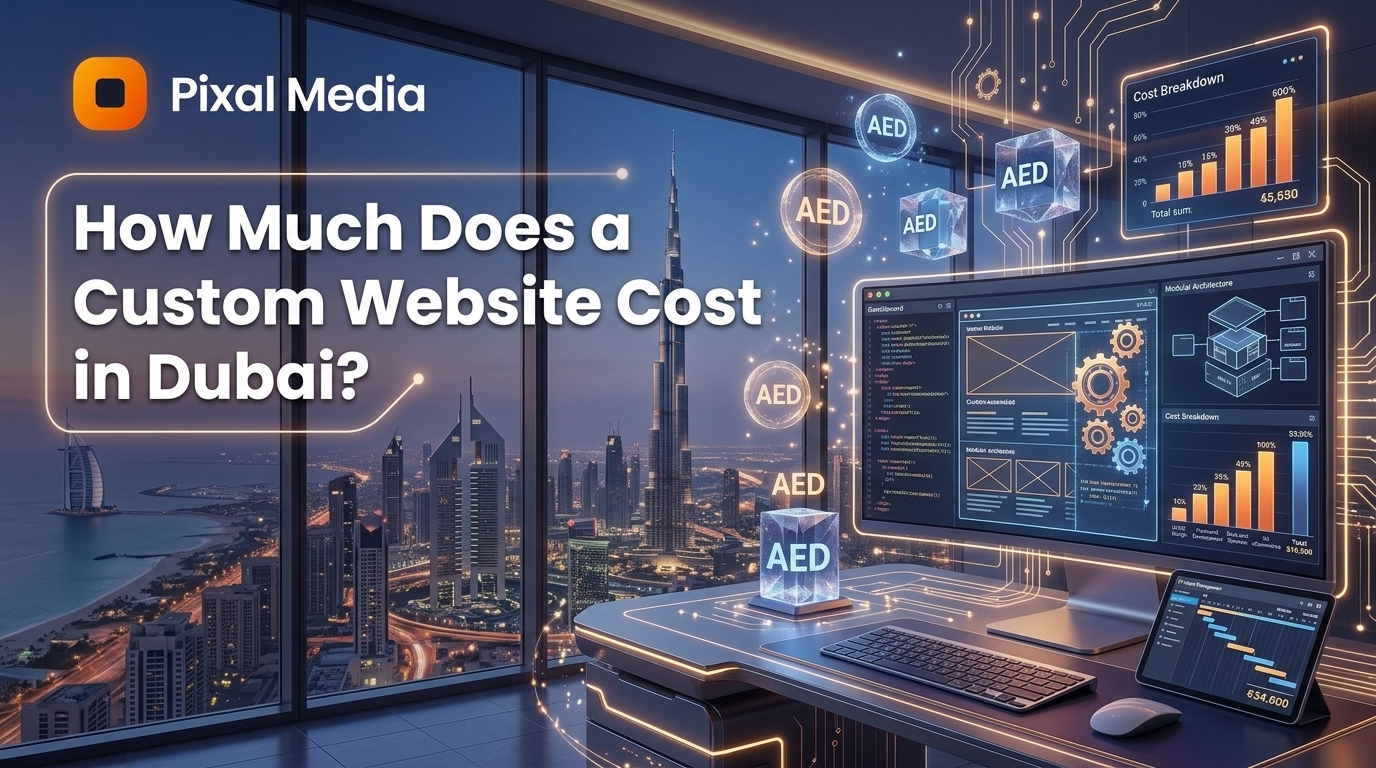
A custom website is more than a digital store front. It’s a business system that behaves like a business, serves customers, and expands. For businesses looking for bespoke web design and development in Dubai, the cost is not just in the initial quote but in the value of the whole solution.
At Pixal Media, our work across Sharjah and Dubai involves understanding business objectives before deciding how a website should be built. Whether a company needs a Web Development Company to create a tailored digital platform or is comparing the best web development company in Dubai, the important question is what the website needs to accomplish.
A custom-built website is not a standard template with small visual changes. Its design, structure, functionality and technical architecture are planned based on specific requirements. That flexibility comes at a different cost structure, but also can create a stronger foundation for long-term business growth.
Key Takeaways
- The price of a fully bespoke website in Dubai may vary from AED 15,000 to AED 250,000 and above depending on the complexity and requirements of the business.
- The key cost drivers are custom UI/UX design, backend architecture, integrations and advanced functionality.
- A custom website usually takes between 8 to 24 weeks to build. More complex websites can take longer.
- Total cost of ownership must include future improvements, maintenance, hosting and security.
- The right investment depends on your business goals, user needs and how much you expect the website to add to growth.
How Much Does A Custom Website Cost In Dubai?
The cost of a fully custom website in Dubai generally ranges from the following estimated prices:
| Type of website | Estimated Cost (AED) |
|---|---|
| Business website tailored for your needs | 15,000–35,000 |
| Corporate website for the sophisticated | 35,000–75,000 |
| eCommerce Website Custom | 50,000–120,000 |
| Web application / portal (complicated) | 100,000–250,000+ |
| Enterprise-grade digital platform | 250,000+ |
These are representative planning ranges and not fixed market prices. Exact quotes depend on scope, design requirements, development team, integrations and testing requirements.
A custom inquiry workflow for a 10 page website may cost more than a larger website with simple information pages. It’s not the number of pages, it’s the complexity of what’s going on behind them.
Businesses comparing website development cost in Dubai should therefore evaluate the deliverables and functionality included in each proposal rather than comparing the headline price alone.
Why Custom Website Development Is Costly?

1. Custom UI/UX Design
User Interface and User Experience designing is what gives a website its look and feel and leads the visitors to useful actions.
Custom design usually starts with a study of the target audience, business goals, customer expectations and current digital experiences. Designers then create a visual direction that represents the brand and is easy to navigate.
Custom UI/UX Process might include: user journeys, information architecture, wireframes, visual design systems and interactive prototypes.
Wireframes are the skeleton of each page, before any visual elements are added.. Prototypes give stakeholders the chance to test navigation and interactions before development.
The more unique the user journeys and interface requirements the greater the investment in design. However, it is usually cheaper to identify usability problems in the prototype than to fix them after the website has been built.
2. User Interface (Front end development)
Front-end development is the process of building a functional website that works with users based on the approved designs.
Responsive Design, Interaction, Navigation, Animation, Forms, Accessibility, Performance Optimization etc.
The front-end requirements for a simple corporate website can be pretty trivial. Developing a custom platform with interactive dashboards, advanced filtering, dynamic content or personalized user experiences would require more development and testing.
The idea is not to clone a design, but to have a consistent experience across devices, browsers and screen sizes.. The point is to:
3. Database Design & Backend Development
The back end is the stuff users never see, but they depend on it every day.
User accounts, content management, booking systems, order processing, payment workflows, permissions and business logic are some of these.
A database’s architecture also affects its cost. The needs of a simple inquiry information website will differ from a website that has to handle thousands of products, customer records, transactions or interrelated business processes.
Custom database structures need to be designed to ensure data accuracy, security, performance and growth in the future. Bad architecture can reduce initial development cost, but add expensive limitations later.
4. Third party integrations
Many businesses need their websites to communicate with other systems.
These could be payment gateways, CRM, accounting software, inventory systems, shipping providers, marketing automation and External APIs.
Each integration takes additional effort to configure, map data, authenticate, handle errors and test.
For instance, tying an e-commerce site to an inventory system can help maintain consistent stock information. But integration has to take into account what happens if one of the systems fails or the data doesn’t sync.
The more critical the integration is to the business, the more careful the implementation should be.
5. Further Advanced Functions
The biggest differences in website quotes usually stem from advanced features.
These can be customer dashboards, multi-vendor marketplaces, booking engines, membership systems, multilingual content management, custom search and automated workflows.
The price of a feature will depend on its complexity, how many user roles are involved and how it integrates with other parts of the website.
Before you start developing, businesses need to distinguish core functionality from features that can be added later. This will allow you to spread the upfront cost out but not lose the experience itself.
ExpectedCost Breakdown Of A Custom Website
A custom website budget can be divided into several major components.
| Development Component | Indicative Cost (AED) |
|---|---|
| Discovery, planning, and wireframing | 3,000–10,000 |
| Custom UI/UX design and prototyping | 5,000–20,000 |
| Front-end development | 8,000–25,000 |
| Back-end development and database | 10,000–35,000 |
| Integrations and advanced features | 5,000–40,000+ |
| Testing, launch, and optimisation | 3,000–10,000 |
These figures are illustrative component-level estimates. They overlap with the overall project ranges and should not be added mechanically to determine a quotation. A project may require more or less work in each category.
A useful starting point is to define the business outcome, identify the required features, and then estimate the work needed to deliver them.
How long does it take to build a custom website?
The time frame for development is based on the amount of planning, design, functionality and testing that is required for the project.
Custom Business Website – 8-12 Weeks Complex portal or web application: 20 to 36 weeks or more. A complex corporate website or eCommerce platform may take 12-20 weeks.
The process is usually discovery and planning, wireframing, design approval, front-end and back-end development, integration, testing and launch.
Delays often happen when requirements change during development, when content is delivered late, or when stakeholders take longer to approve designs.
Clear requirements and decisions on time to be in the expected budget and schedule of the project.
Ongoing costs and maintenance

Building a website is not the end of the investment, but the beginning of the life of a website.
Examples of such recurring expenses include hosting, domain renewals, security monitoring, backups, software updates, bug fixes, performance optimization, and technical support.
Companies should spend 10 to 20 percent of the cost of initial development each year on maintenance and enhancement. Actual costs will depend on the complexity of the site and the support contract.
Websites that have many transactions, store sensitive customer data or have mission critical workflows usually need more consistent monitoring and support.
Security should also be considered from the beginning. The OWASP Web Application Security Risks provide a useful reference for understanding common vulnerabilities that development teams should address.
Businesses can also review the Google Search Essentials to understand how technical accessibility and search-friendly website practices support discoverability.
Is it worth it to spend money on a custom website?
How much does a custom website cost? It is contingent upon its suitability to the business.
Imagine a company that gets hundreds of inquiries a month. A custom qualification form, CRM integration and automated routing process can reduce manual work and allow the sales team to respond more efficiently.
Custom checkout experience for your eCommerce business can help you remove the unnecessary steps. If a service company wants to make scheduling easier and cut down on admin work, a booking system would be good.
We can think of the ROI in a simple framework as:
Business Value = Revenue Growth + Cost Savings + Operational Efficiency
These benefits must be weighed against the cost of development, maintenance, hosting and future enhancements.
A custom-built website isn’t a requirement for all businesses. If the requirements are simple and not expected to change a simpler solution may be economically viable. Custom development is particularly appealing when your website needs to support specific processes, a differentiated customer experience or the potential for future growth.
Businesses evaluating a web development agency in Dubai should ask how the proposed architecture supports future needs, what is included in the quotation, and how ongoing support will be handled.
How to get a web design quote in the UAE
A good quotation begins with a crisp brief.
Before you request a web development quote UAE, outline your business goals, target audience, required pages, essential features, integrations, content responsibilities, and expected launch date.
It also helps to identify what can be introduced later on. That means developers are able to focus on the most valuable functionality, without building everything at once.
Require each vendor to detail their scope, timeline, design process, technology choices, testing, ownership & maintenance terms. A detailed proposal helps people understand where the money is going and what the project is supposed to do.
For businesses comparing regional providers, reviewing the best web development company in UAE can also help establish a broader understanding of available services and approaches.
Conclusion
The cost of a custom website in Dubai hinges on the choices you make both before and during the development. The last investment consists of design, architecture, integrations, functionality and maintenance.
The most useful approach is to begin from business needs, not a fixed budget. A well thought out website should solve real problems, provide users with a clear experience and be adaptable as the business grows.
Website is not a project that ends when it is launched. It’s a digital asset that appreciates in value as long as it’s serving people and driving meaningful business outcomes.
FAQs
How Much Does a Custom Website Cost in Dubai?
A fully custom website for most business and corporate projects will run somewhere in the ballpark of 15,000 AED to 75,000 AED. Advanced eCommerce platforms, portals and enterprise systems can cost more than AED 100,000 based on the functionality.
What is the Cost of Developing a Website for Small Business in UAE?
A custom design and required functionality for a small business can cost from AED 15,000 – AED 35,000. The total cost will depend on the complexity of the page, content requirements, integrations, and level of customization.
How long does it take to make a custom website?
How long does it take to develop a custom business website? The time to build a custom business website is usually 8 to 12 weeks. Building complex corporate sites can take 12 to 20 weeks. Depending on the development and testing requirements, complex web applications can take several months.
Custom Web Design Vs Template: What Should You Opt For?
Custom design gives you more control over business process, functionality and user experience. Templates are great for simple needs but custom development is great when a standard layout is not good enough for particular needs.
Does the cost of building a website include maintenance?
Not really. Maintenance can be provided under a separate contract including hosting, updates, backups, security and technical support. Businesses should look into any ongoing costs and service responsibilities before signing the development contract.
What should I ask for when getting a quote for a website?
Describe your business goals, the key features you’d like to see, how you envision the site architecture, any integrations you require, your design preferences, content needs, timeline, and maintenance plans. A clear brief enables developers to provide better estimates and reduce scope changes.
Build a website for your business goals
At Pixal Media we believe a website should be designed for the people using it and the business it serves. We combine design, development, marketing and security to assist businesses in making smart digital decisions.
If you are planning a custom website, talk to Pixal Media about your goals, requirements, and expected outcomes. We can help you define a practical scope, understand the investment involved, and plan a solution that supports sustainable growth rather than simply delivering a website at launch.
The best investment isn’t always the most feature-rich site. It’s the one that continues to generate value long after the project is done.

1 comment