How Long Does It Take to Develop a Website in the UAE?
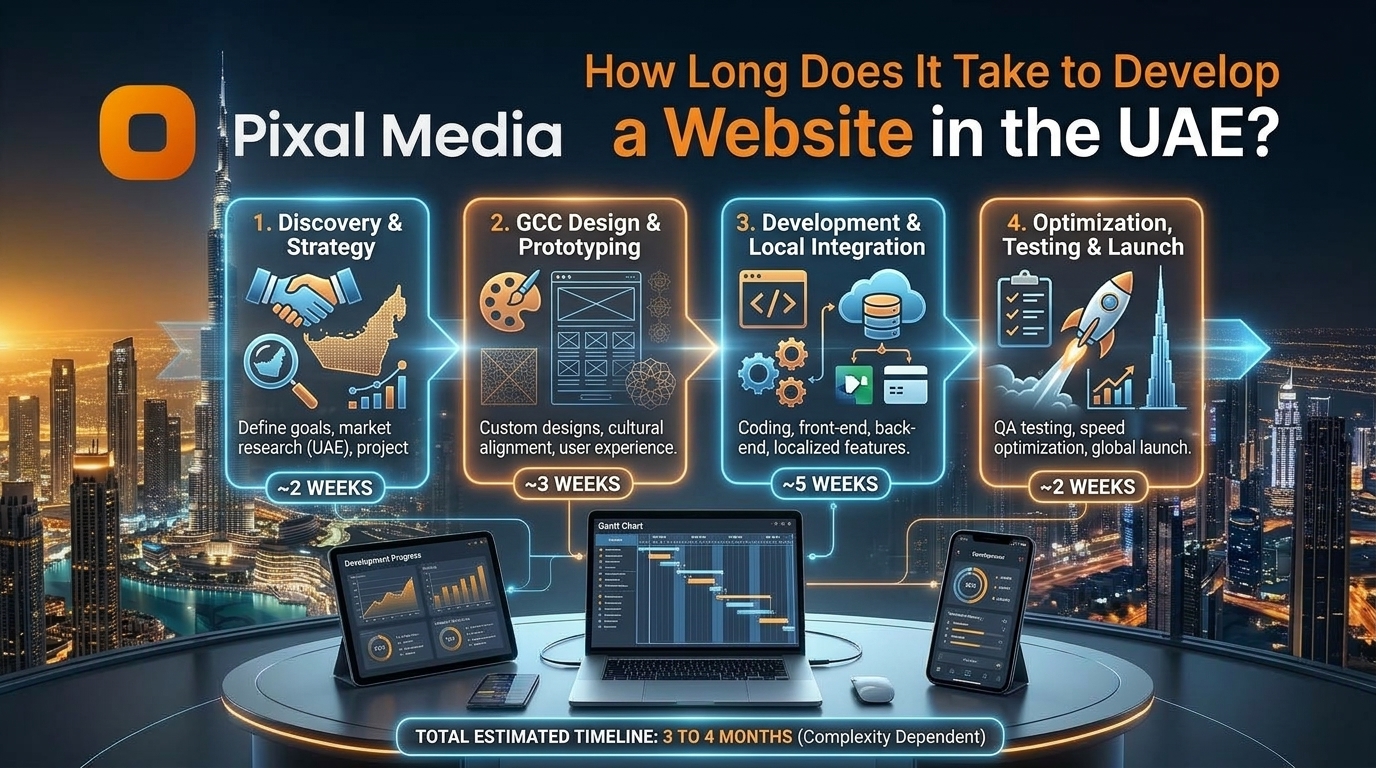
It is rare that building a website is just a matter of designing a few pages and putting them on the web. For UAE businesses, the time it takes to build a website in the UAE depends on the project’s scope, design requirements, content readiness, technical complexity and approval process. A simple business site can be done in a couple of weeks, while a full corporate platform or an eCommerce website can take several months to build.
Understanding the timeline becomes easier when businesses work with an experienced Web Development Company that can manage planning, design, development and testing within one coordinated process. Choosing the best web development company in UAE is not simply about finding a team that can build quickly. It’s finding one that can set realistic deadlines, while not compromising the quality of the end product.
How much time does it take to build a website in the UAE?
There’s no set time for building a website. It really depends on what the website is supposed to do, and how much functionality it needs.
The following timelines are a good starting point for common website projects for planning purposes. These are estimated time frames, not guaranteed delivery times.
| Type of Website | Estimated Development Time |
| Simple Landing Page | 1-2 Weeks’ |
| Small Business Websites | 3-5 weeks |
| Company Website | 5-8 weeks |
| Custom Business Web Site | 8-12 Weeks |
| eCommerce Web Site | 8–16 Weeks |
| The Complex Web App | 3-6 months or longer |
A basic landing page needs fewer design decisions and less technical stuff. A corporate website needs more focus on page structure, content, user experience and business objectives.
An eCommerce platform adds things like product management, payment integrations, checkout functionality and order handling to the list of responsibilities. Custom web applications require even more planning since the features must often be designed and developed around specific business operations.
For a more detailed financial breakdown, businesses can also explore website development UAE costs, as budget and project scope are closely connected.
Know Website Development Timeline: Step-by-Step

There are a number of related steps in the development of a website. Each stage builds on the one before, so rushing any part can mean more work down the road.
Here’s how the typical website development process works.
1. Requirements planning and analysis (1-2 weeks)
For a successful website, you need to be clear on the business requirement.
The development team will at this point discuss the company’s aims, target audience, competitors, desired site structure and required functionality. This could also include identifying whether the website for a UAE business needs to be in both Arabic and English, have location specific content or integrate with existing business systems.
Then the team builds a sitemap, defines the project scope and technical requirements. These documents are used to determine what pages and features will be included in the first launch.
The most important part of planning is deciding what the site should do. The structure of an online retailer with hundreds of products will differ from a company looking for inquiries.
Planning can be extended by unclear requirements, changing business priorities and delayed stakeholder decisions. Early agreement on scope means fewer interruptions for the development team.
2. UI/UX Design & Website Wireframing (1-3 Weeks)
Once the project needs are understood, the design process begins.
UI (User Interface) is the appearance of the website, like colors, fonts, layout, images. Ultimately it is about how easy it is for visitors to use the site and find what they are looking for.
Designers usually begin with simple wireframes and then move on to detailed designs that describe how the final site will look. This way, the business knows how the visitors will navigate between pages and use different features.
For example, a property company in Dubai wants to make property listings and inquiry forms very visible. A professional services company may, in contrast, be more focused on its services, past projects and consultation options.
Also, the design should consider mobile users. Responsive layouts are very important because visitors may visit the website through smartphones, tablets and desktop computers.
What can cause this stage to be delayed?
Frequent design changes, different opinions from stakeholders and last minute changes to page structures can result in a longer timeline. Consolidating feedback helps designers get to approval faster.
3. Content Creation and Preparation (1-3 Weeks)
One thing that’s often underestimated when calculating the time to build a website is content creation.
Each page needs to have information that explains the business, its services and what it can provide visitors. This includes website copy, service descriptions, images, product information, testimonials and any other material relevant to the work.
Translation and localization into Arabic may also be part of content preparation for UAE businesses. If a website caters to both English and Arabic speaking audiences then the content structure and right-to-left layouts need to be considered.
Content can be developed at the same time as the design, eliminating unnecessary waiting periods. However, if the development team has to wait for approved text, images or translations, the project may not be finished even if the technical work is moving along.
The best way is to prepare the essential content before the start of the development and then finalize it as per the approved page structure.
4. Web Design And Programming (2-6 Weeks)
The approved designs meet here as a working website.
Developers build both the front end – what visitors see and interact with – and the back end, which manages information, functionality and administrative operations.
It is contingent upon the technology you choose and how many features there are how long it takes to develop. A typical WordPress site will generally need less bespoke programming than a bespoke platform with specialist business functionality.
Common stages of development can be navigation menus, contact forms, content management systems, service pages, databases, payment gateways, and third-party integrations.
For companies comparing development approaches, knowing web developer companies in UAE can help to clarify the differences in technical capabilities and project delivery methods.
You can then add more requirements like booking systems, customer dashboards, inventory management or support for multiple languages.
5. Website Testing & QA (1-2 weeks)
Before the website goes live, the team needs to ensure that everything is in order.
They check how the website looks and works on different browsers and devices. This covers testing links, forms, images, navigation, loading speed, and other features.
The team also checks product pages, shopping carts, checkout and payment options for an eCommerce website. They make sure that the customer information is protected enough, especially when the site is taking online payments.
Accessibility should also be considered. The W3C Web Content Accessibility Guidelines (WCAG) provide recommendations for making websites more accessible to people with different abilities.
For additional technical checks, the OWASP Web Security Testing Guide provides a useful framework for evaluating web application security.
Here we test to find problems before customers do.
6. Editing & Final Editing (3-7 Days)
After testing is finished the development team will send the finished website for review.
The completed pages are reviewed by the business owner and other stakeholders to ensure the original requirements have been met. At this stage they have a chance to request small changes. Text changes, graphic changes, layout changes, functionality changes.
It is important to distinguish between minor revisions and scope changes of the original project Adding a new booking system is not just a cosmetic fix to a button.
You can make this phase more predictable by deciding on the number of rounds of revision and the approval process in advance.
7. Website Deployment (2-5 days)

Once the site is approved, the team prepares it to go live.
This involves connecting up the domain, setting up the hosting, securing the website and making sure everything works properly.
The team will also go through important SEO settings so that the search engines will be able to find the website before it goes live.
In case the project replaces an existing website, old URLs may need to be properly redirected.Google’s Site Moves And Migrations Guide explains how to manage URL changes and monitor a website migration.
After deployment the team should test important pages and forms on a live website. Launch is not just the moment a website is publicly accessible; it is the moment the completed system is verified in its real environment.
What can speed up or slow down the development of a website?
Even with a detailed project schedule, the actual delivery date may vary. Many of these are within the control of the development team, others are not and depend on the business.
The most common influences are
Technical Difficulty & Size of the Project
If you are creating a website with 5 pages of information, it will be less resource-intensive than a platform with user accounts, payment processing, and custom dashboards.
Adding functionality as you go can also impact the original schedule. If essential features are defined before work begins, it is easier to keep to a timeline.
Content And Material Readiness
With text, images, branding assets and product information on hand, designers and developers won’t have to wait unnecessarily.
Missing content can cause delays as page layouts, translations and final formatting all depend on the information being provided.
Speed of client feedback and approval
A project may be technically ready for review, but sit idle while the business waits to sign off on designs or provide feedback.
You can minimize these interruptions by appointing a single decision maker and giving consolidated feedback.
Language and region requirements
Depending on your target audience, websites in the UAE may need to have Arabic localization, right-to-left layouts and country-specific content.
Those requirements should be discussed in planning, not introduced shortly before launch.
How can UAE businesses accelerate website development?
Faster development times doesn’t mean asking developers to work faster. Often, better project preparation makes a much bigger difference.
Businesses can improve delivery by setting out their website requirements clearly upfront, having content ready before the development stage, approving designs within agreed timeframes and not making unnecessary changes once the scope is set.
For example, businesses evaluating the best web development company in Dubai or the best web development company in Sharjah should consider how each team manages communication, project milestones and quality assurance.
An unambiguous development schedule should contain responsibility, approval dates, deliverables and testing requirements. That way there is accountability but without compromising the quality of the final website.”
Why You Need a Realistic Web Design Timeline
A website isn’t a project to be finished by a certain date. It’s a long-term business asset.
If you launch too soon your business may be left with broken forms, incomplete content, poor navigation or technical problems. In contrast, letting a project go on forever with constant changes might increase the costs without adding any value.
The aim should be to find the right balance between delivery time, functionality and quality.
At Pixal Media, we bring together web and app development, marketing, design and security under one roof. We start with the business understanding, defining the target audience and the business goals of the project. This means we can plan development according to real needs, not some arbitrary date.
Conclusion
So, how long does it take to develop a website in UAE? A simple business website can take 3-5 weeks, while a large corporate or ecommerce project can take several months.
The more important consideration is understanding what happens during that time. Planning, design, content preparation, programming, testing and launch all contribute to the final outcome.
A properly developed website should not only be delivered on time, but also fulfill its purpose after launch. A few extra days spent making the right decisions pays off in the long run more than saving time by overlooking them.
FAQs
1.Can You Build A Website In A Week In UAE?
Yes, it is possible to build a simple website or a landing page or a template based website in one week, if the design, content, domain and requirements are ready. More complex functionality will take much longer.
2. How Much Time Does it Take to Create a WordPress Site?
The average time to build a business website on WordPress is three to six weeks. It is contingent upon the number of pages, customization, content requirements, integrations and approval process. This can be extended using custom functionality in WordPress.
3. Does Website Content Affect Development Time?
Yeah. Content delays, missing images, incomplete product info and waiting for translations can all slow down building pages. And key materials will be prepared and approved in advance to keep the project on track.
4. How Much Time Does It Take To Develop An eCommerce Website In UAE?
The time to build an eCommerce site varies with the number of products, payment integrations, inventory management, shipping needs, checkout features and testing. Typically it takes eight to sixteen weeks. It takes more time to build the more complex the platform is.
5. Do I build the site and the content at the same time?
Yeah. Once the page structure is decided, content preparation can be done in parallel with UI/UX design and early development. This means less waiting and a team can move through the various phases of a project more efficiently.
6. What is the most common cause for delays in website development projects?
The most frequent causes of delay are: unclear requirements, changes of scope, late delivery of content and slow approval processes. Early agreement on project responsibilities and deliverables can help avoid unnecessary interruptions.
Pixal Media website development plans
Good decisions make for successful websites, not rapid development schedules. At Pixal Media, we partner with businesses to understand their goals, plan the development process, and build long-term digital solutions that help them grow.
If you need a corporate website, eCommerce platform or bespoke digital solution we focus on building a practical development roadmap with clear expectations at every stage.
Explore Pixal Media’s Web Development Services and let’s discuss the right timeline for your next website project.



Comments